The Discipline of Vision
- Troy Anthony
There is a difference between creating and seeing.
Most believe art begins with expression, a release, a spontaneous act of inspiration. “But expression without vision is noise, temporary.. forgettable.”
Vision on the other hand is something else entirely.
It is clarity. It is restraint. It is the ability to see something fully formed before it makes sense and the world has language for it. It demands patience in a culture that rewards immediacy, and conviction in a world that constantly asks for explanation.
To have vision is to be misunderstood.
The disciplined artist, a true artist does not chase validation. They do not create to be agreed with. They create because they have seen something precise, something undeniable, and their responsibility is to bring it into form with as little compromise as humanly possible.
This is where discipline enters.
Discipline is not restriction. It is refinement. Read that again.
It is returning to the work until it sharpens. Removing what is unnecessary. Carving, cutting, painting, photographing. Choosing intention over impulse, again and again, until the work begins to carry weight.
Because weight is what separates decoration from art.
Decoration is immediate. It is pleasing, accessible, easily consumed. But it does not stay with you.
Art demands something. It simultaneously adds to the world while taking a small piece from the artist.
It asks you to slow down. To confront. To feel beyond what is comfortable. It introduces tension, between beauty and truth, control and chaos, what is seen and what is understood.
This tension is not accidental. It is constructed. It is truth.
And construction requires discipline.
The artist decides what remains and what is removed. What is said and what is left unsaid. Every line, every texture, every absence carries meaning when vision is present.
Nothing is arbitrary. Nothing.
In this way, art becomes less about creation and more about alignment, aligning what is internal with what is external, intention with execution, vision with form.
This work is not easy.
It requires sitting with uncertainty without rushing to resolve it. Continuing refinement when others would call the work complete. Holding a standard not dictated by trend, but by truth.
The truth of the work.
Over time, this discipline builds something rare: trust in your own eye.
And once that trust is established, everything changes.
You no longer create to discover what you think. You create to reveal what you already know.
That is the shift.
That is the difference between someone who makes art and someone who carries vision.
And in the end, vision is the only thing that lasts.
— Troy Anthony
Know Galleries
__________________________________________________
Create First. Be Understood Later.
- Troy Anthony
There is a pressure to explain everything, to make the work immediately digestible, immediately accepted, small bites, easy to chew, then swallow, simple and in that order.
“But clarity does not always arrive at the same time as creation”.
Some ideas are ahead of their moment. They exist before language, before consensus, before the world knows how to receive them.
The mistake is believing that understanding must come first. It doesn’t. Creation does.
To create with vision is to move without full permission.
It is to trust what you see before you see it, to trust before it is validated, to follow a direction that may not yet make sense to anyone else.
This is where most humans hesitate, they adjust, they simplify, they dilute, they become safe.
But the artist who holds their position, who allows the work to remain intact, is the one who defines what comes next.
Although deeply tempting, understanding is not something you chase. It is something that arrives, gradually, and often after the fact. The work introduces the idea, and over time, the world catches up, or not.
What once felt unfamiliar becomes influential. What once felt misunderstood becomes undeniable. That is the order: create first, and allow meaning to follow.
— Troy Anthony
Know Galleries
__________________________________________________
Why Great Art Feels Dangerous
By Troy Anthony - March 2026
“Great art has never been safe. Never”.
It has never existed to comfort, to decorate, or to quietly exist in the background of a room. At its highest level, art disrupts. It’s deeply uncomfortable. It introduces something unfamiliar into a space that was previously understood.
And that unfamiliarity can feel deeply threatening, alarming, dangerous.
It removes us from spaces once held sacred and from beliefs once held true. Art challenges our preconceived notions of who and what we think we are on multiple levels.
Not in a literal sense, but psychologically, emotionally, even spiritually. Because great art has the ability to push perception. It can shift the way someone sees themselves and even the world they live within.
Most people don’t expect that from art.
They expect beauty. Harmony. Something agreeable. Something to hang on the wall. Something that fits easily into their existing framework of taste and understanding.
But great art does not ask for permission to fit.
It creates tension. It creates struggle.
Tension between what is seen and what is felt. Between what is understood and what remains just out of reach. It invites the viewer into a moment of uncertainty, where interpretation is not immediate, and meaning is not handed to them.
This is where discomfort begins.
And discomfort is often misunderstood.
It is mistaken for confusion. Rejection. Even failure. But in reality, discomfort is a signal. It is an indication that something new is being processed, something that has not yet been fully resolved.
Great art lives in that space.
It does not rush to explain itself. It does not dilute its message to become more accessible. Instead, it holds its position, allowing the viewer to meet it halfway, or not at all.
This is what makes it powerful.
Because when someone chooses to stay with the work, when they allow themselves to sit in that tension, something begins to shift. The unfamiliar becomes intriguing. The tension becomes intentional. The discomfort becomes awareness.
And awareness changes everything.
It expands perception. It deepens emotional range. It creates a new reference point for what art can be.
But this only happens if the work is willing to risk being misunderstood.
If it is willing to stand without immediate validation.
If it is willing to be called too much, too intense and even too different.
Because what is considered “too much” is often what defines a new standard.
This is the line that separates safe work from significant work.
Safe work is accepted quickly. It is easy to process, easy to place, easy to move on from. It requires nothing from the viewer beyond a glance.
Significant work requires presence.
It asks for time. Attention. Openness. It invites the viewer into a relationship rather than a transaction.
And relationships, real ones, are never surface level.
They are layered. Evolving. Growing. Changing. Sometimes uncomfortable. But ultimately, they leave an impact.
That impact is what makes the work last.
Long after trends shift. Long after styles change. Long after what was once popular fades into the background. Long after I am no more.
The work remains because it created a moment that could not be ignored.
This is why great art feels dangerous.
Because it has the power to stay with you.
To challenge you.
To change you.
And once something changes the way you see, you can never unsee, you cannot return to seeing the same way again.
That is not decoration.
That is transformation.
— Troy Anthony
Know Galleries
__________________________________________________
Mind your Mindset
By Troy Anthony - March 2026
Your mindset isn’t something you switch on when it’s convenient for you, it’s something deep within, primary and core. It’s something you guard like territory.. something you refuse to allow entry or passage.
Every day you choose to create there’s noise: opinions, distractions, people projecting their fears like they’re facts. But you will soon realize that not everything deserves your attention, and definitely not your energy.
Your first line of defense to protect your mind is confidence, it’s the quiet decision maker, its the fuel, the juice.. confidence is what whispers in your ear telling you what to ignore, what to walk past, and what to refuse to let live in your mind rent-free. Build a life where clarity is currency, and peace is protected at all costs.
“There’s power in moving with intention, in knowing who you are without needing constant validation.”
“Don’t chase noise, outgrow it.”
The more you believe in yourself, the more you create and increase the ability to see yourself with inner eyes, a divine gift that allows you to see what others can’t by using this special sight to see things when your eyes are closed and your mind is truly open.
Everything doesn’t deserve your energy, you don’t have to respond to everything, you don’t have to explain your vision to everyone. Some decisions, some moves are meant to be silent until they speak for themselves. That’s where true elevation is refined, and cutting through everything that doesn’t align with where you’re going.
— Troy Anthony
Know Galleries
__________________________________________________
The Process
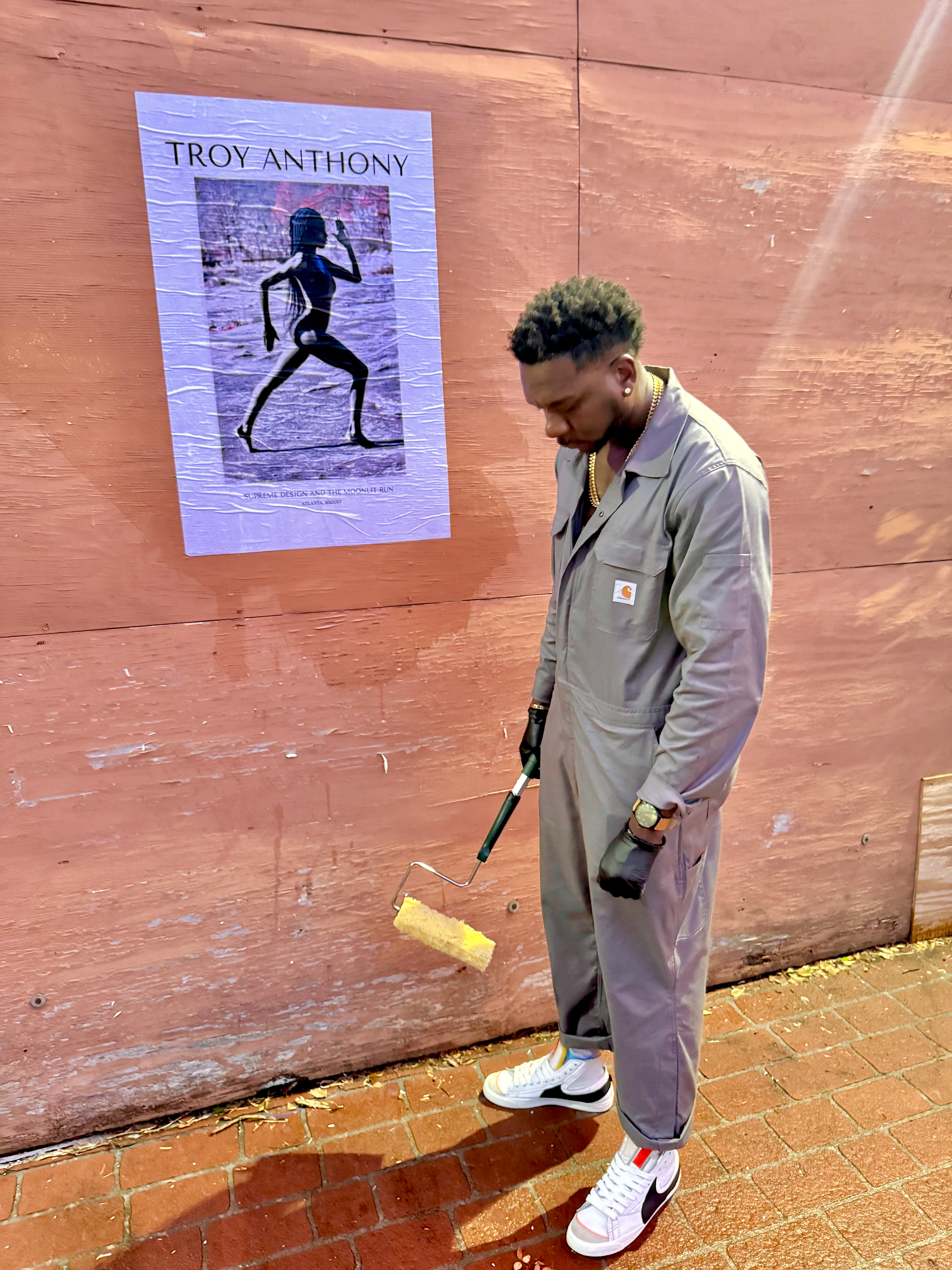
The artist Troy Anthony - Atlanta, 2025 - Know Galleries